Productivity - or improved productivity - is not necessarily getting more things done by yourself or adding more things to your plate. It is being smarter with the things you have to get done and deciding what needs to get done now, what can be left undone and what can be delegated.
We as leaders need to help our teams improve their productivity through better planning, organization and delegation. If our teams are not as productive as they need to be we need to look at ourselves and decide where we need to be better.
Sunday, June 29, 2014

Friday, June 27, 2014
A Quote
“If you think about disaster, you will get it. Brood about death and you hasten your demise. Think positively and masterfully, with confidence and faith, and life becomes more secure, more fraught with action, richer in achievement and experience.”
― Swami Sivananda
― Swami Sivananda
Thursday, June 26, 2014
How Rodney McMullen Took Kroger to the Top

At the Kroger Co., executives often learn the business from the ground up – starting as clerks or cashiers before getting the attention of middle or senior managers and ascending the corporate ladder.
On Thursday, 36 years after he started as a stock boy, Rodney McMullen will be the face atop that ladder – presiding at his first annual meeting as the CEO of the $100 billion corporation.
Humble to a fault, McMullen's easy-going demeanor belies the critical roles he's played for years before becoming CEO on Jan. 1. He's been intimately involved in the strategy that has grown Kroger's sales every quarter for 10 ½ years – transforming shopping for American consumers who want a viable alternative to Wal-Mart.
The company, by the way, is kicking its Arkansas-based competitor's ass – something Wall Street has noticed. Kroger's stock hit an all-time high of $50.20 last week even as the rest of the grocery industry appears in peril.
"You would never know what a talent he was if you just knew him casually, he's not the type to brag, he's not aggressive," said Bill Sinkula, a mentor and Kroger's former chief financial officer. "He was a key player on every major decision after 1987 when he was just a kid."
Besides reshaping the U.S. supermarket industry, Kroger has also quietly helped sustain downtown Cincinnati's renaissance. The retailer co-founded the consumer insights firm dunnhumbyUSA, which now boasts 600 local workers and is building a new headquarters that will be part of the city's thriving marketing and branding intelligentsia.
At the annual meeting, McMullen and predecessor board chairman David Dillon will recap a year where Kroger turned a $1.5 billion profit and the company closed on a $2.5 billion acquisition of Harris Teeter.
The new CEO will likely affirm Kroger's Customer 1st strategy that countered Wal-Mart's strategy rather than trying to replicate it.
HUMBLE START LEADS TO BIGGER THINGS
McMullen's rise to the corner office coincides with Kroger's triumph amid unprecedented competition and turmoil in the supermarket industry in the 21st century.
Born in Pineville, Kentucky, near the border of Tennessee and Virginia, McMullen grew up around the Bluegrass State and Southwest Ohio as his parents, William and Henrietta, moved to work at various factory jobs.
"My parents had the kind of jobs where if the economy went soft, you got laid off," McMullen recalls. "You don't want anyone to have the fear I had growing up."
The McMullens accepted the ups and downs and didn't hide the realities from their only child. His parents coped with a frugal lifestyle but encouraged him to pursue an education and more stable future.
"They thought college education would have more security," McMullen said.
In what became a pattern, McMullen went a little further. He not only worked his way through college, but he got a master's degree – all in four years.
McMullen took his first job at Kroger in 1978 in Lexington, trying to become the first one in his family to ever go to college, and to maybe become a lawyer.
His factory-worker parents saved for only one year's college for their son, but hoped it would work out. McMullen made it through the University of Kentucky by working nights as a stock boy and picking up every extra shift he could.
"My parents figured if there's a will, there's a way," McMullen said. "I worked every job in that store, from the dairy to the deli."
At Kroger, McMullen became invaluable, working every job and shift in the store. He even came up with a way to sell more fruit baskets out of the produce section.
Ironically, the only job he wasn't good at was cashier. Studying to become an accountant, he wasn't fast at punching in customers' orders into cash registers.
Toward the end of his studies, the local vice president of operations asked him if he'd be interested in working for Kroger.
Planning on joining an accounting firm, McMullen instead ended up working in Kroger's Charlotte, North Carolina, division office as an accounting supervisor.
McMullen quickly caught corporate's attention. His office acquired a personal computer and he helped train everyone in the office on it. Tasks that had taken a day were being done in 15 minutes; productivity surged.
McMullen was made a financial analyst in 1986 and moved to Cincinnati where his numbers and computer savvy were soon put to a larger test.
HOLDING OFF THE BARBARIANS AT KROGER'S GATE
In 1988, McMullen played a critical role in Kroger's restructuring – beating off corporate raiders from Wall Street attempting to take over the company in a leveraged buyout.
CEO Lyle Everingham, president Joe Pichler and CFO Sinkula pushed through a plan for Kroger to borrow more than $4 billion and distribute it to shareholders in a one-time dividend. McMullen crunched the numbers that predicted the future cash flow needed to pay off the debt.
The result was shareholders got a premium for their stock and Kroger stayed a public company.
"He was so good at doing the calculations in record time," Pichler recalled. "He ran with the best on Wall Street."
McMullen succeeded Sinkula as CFO from 1995 to 2000, then began moving into more operations. He became the executive vice president of strategy, planning and finance in 2000.
He oversaw the integration of the $13 billion Fred Meyer acquisition in 1999 that made Kroger the nation's largest supermarket chain.
But just as Kroger found its way to the top, the industry competition intensified as never before.
FACING THE BOOGEYMAN FROM BENTONVILLE
Toward the end of Pichler's tenure, Kroger's growth began to elude the retailer as nontraditional rivals – drugstores, dollar stores and discounters – discovered they could sell more groceries to drive traffic.
"Sales had begun to flatten and our divisions said our prices were out of whack with Wal-Mart," Pichler recalled.
McMullen was a key player on the team that figured out how much Kroger could grow sales if it cut prices. Then Kroger would use the additional money to cut prices further, spurring further growth, Pichler said.
For a time, Wall Street punished the stock because investors were worried the company was pursuing a smaller profit.
They were right: Kroger's gross profit margin – the money left after paying for merchandise that's sold to customers but before operating expenses such as labor are paid – has dropped from 27.4 percent in 2002 to just 20.6 percent in 2013.
But Kroger thrived by taking a smaller slice of a bigger pie, as sales doubled in the ensuing years from $50.1 billion in 2002 to $98.4 billion last year (excluding $4.7 billion at newly acquired Harris Teeter).
Kroger continued to refine its strategy to broaden its appeal beyond just price.
When David Dillon became CEO in 2004, Kroger developed its "Customer 1st" strategy. The plan was not to beat Wal-Mart on price, but to be competitive on price and also offer more product variety, better service and a more inviting shopping experience.
Informing the new strategy was a key investment: Kroger in 2003 founded a U.S. joint venture with London-based consumer insights firm dunnhumby. The joint venture became the brains behind Kroger's loyalty card program, offering customers bargains in exchange for tracking shopping patterns.
Kroger has used dunnhumby data to send coupons to customers for items they've purchased in the past. Kroger has also learned that parents packing lunches for their kids prefer juice boxes in the same aisle as crackers.
As Kroger's strategy continued to gain it market share, the company paved the way for McMullen to succeed Dillon.
McMullen became president and chief operating officer – Kroger's No. 2 executive – in 2009.
McMullen says he benefited from working with Everingham, Pichler and Dillon: "The last 25 years, I've worked with legends."
SHOWING UP AT STORES UNANNOUNCED
Kroger today runs 2,640 supermarkets in 34 states and the District of Columbia. It employs 375,000 workers.
McMullen brushes aside questions about more potential acquisitions, saying Kroger is concentrating on getting the Harris Teeter integration right. It's also growing by pleasing existing Kroger shoppers as it expands and upgrades stores.
Kroger gave McMullen the key to the Lexington store he started at when it was replaced by another location in the 1990s. He keeps it in his office.
In recent years, Kroger has ramped up construction of larger-format Marketplace stores as part of its $2.8 billion to $3 billion in forecasted capital expenditures this year. But Kroger isn't cloning Wal-Mart supercenters, keeping the emphasis on food.
McMullen, who was paid $8.8 million last year, keeps a busy schedule and is on the road half the time. He tries to visit all 20 divisions three or four times a year.
Flying coach as much as the corporate jet, he meets with division officials and then they show up at local stores unannounced. He makes a point of talking with everyone, from department managers to checkers, to get a sense of what shoppers want and are responding to.
McMullen, an Anderson Township resident, is a familiar presence at the local Marketplace store there, as well as the Newport Pavilion store. "It's important to see stores as the customer sees it," he said.
From the grassroots
Kroger boasts a number of top executives who rose from junior positions. Several shared accounts of how they were mentored:
• Mike Ellis, 55, president and COO
Started as a clerk in a Fred Meyer store during high school in Vancouver, Washington, in 1975.
"In 2004, I left Portland, Oregon, to accept a position as group vice president of procurement in Cincinnati. My new boss was this tall, commanding presence by the name of Don Becker. Don taught me the value of people. ... Take care of people and the rest is easy."
• Marnette Perry, senior vice president, strategic initiatives and operations
Started in 1972 as a part-time cashier in Athens, Ohio
" I have benefited from mentors all along the way. Early on, my very special mentorship from Dick Bere, then president of our Columbus division and later Kroger's president, lifted my aspirations and confidence."
• Sukanya Madlinger, 51, president, Cincinnati/Dayton division
Joined as a store management trainee in Cincinnati in 1986.
"Within my first 30 days of being a store management trainee, I had the opportunity to meet Don Becker during a store visit at our Hartwell location. At that time, Mr. Becker was the director of operations for the Cincinnati/Dayton division of Kroger. He actually took the time to meet me and chat with me about my background and career aspirations with Kroger. From that day, Mr. Becker mentored me. To this day, I believe in the importance of reaching out to associates at all levels and encouraging them to reach for the stars."
• Michael Donnelly, senior vice president of merchandising
Started stocking shelves at night with Fry's Food Stores in Northern California in 1978.
"The person that helped shape my career and influenced my thinking in the early days was Dave Dillon. I met Dave in 1984 when I was a store manager. Dave was our regional vice president at the time. He has helped mentor me for the last 30 years or so. He has influenced and guided me in many ways throughout my career."
• Mike Schlotman, 56, senior vice president and chief financial officer
First Kroger job was in financial reporting, managing SEC filings in 1985.
"(Former) CFO Bill Sinkula taught me really hard work, teamwork, delegation and perseverance."
• Reuben Shaffer, 63, vice president & chief diversity officer
Began career as a management trainee in 1988.
"I credit my success to two individuals: Bob Hodge, former president of the Cincinnati/Dayton division; and Don Becker, former senior group vice president. My early experience that convinced me I was with the right company."
• Lynn Marmer, 61, group vice president of corporate affairs
Joined Kroger in 1997 as a senior attorney in the legal department. Elected first woman officer in 1998.
" Marnette Perry and Dave Dillon taught me the grocery business."
(from http://www.cincinnati.com/story/money/2014/06/25/rodney-mcmullen-took-kroger-top/11387153/ )
Wednesday, June 25, 2014
Fix it!
"Fix it!"
Customers do not care about our organizational chart. They don't care who's department it is...all they want is their issue taken care of.
So...we must "Fix it!" We'll worry about the details later.
(something short and sweet today...!)
Customers do not care about our organizational chart. They don't care who's department it is...all they want is their issue taken care of.
So...we must "Fix it!" We'll worry about the details later.
(something short and sweet today...!)
Thursday, June 12, 2014
The Brand Called You
A few weeks ago I was asked to speak at a conference within Kroger and talk about personal branding. Since I couldn't be at the conference in person I was then asked to present via video. I decided to take a chance and create the video myself. I tried to do a white screen background first but I wasn't satisfied with the results. I just couldn't get the white background bright enough. It looked bright in the room but once on video it was too drab. So...I went to a black background.
One thing I found out while taping this...it's hard to keep your energy going without an audience to feed off of...and you think you're doing ok while you're doing it but when you watch it back you're like, "what in the world!?" (Actually, me and my daughter Brianna laughed A LOT while watching this video back)
It was fun though and while it might not be a professional video at least I can say is that I gave it a shot!
(update - I have changed the video that will be used at the conference slightly. I believe it made things flow better. I'll let you guys know what kind of response it gets!)
One thing I found out while taping this...it's hard to keep your energy going without an audience to feed off of...and you think you're doing ok while you're doing it but when you watch it back you're like, "what in the world!?" (Actually, me and my daughter Brianna laughed A LOT while watching this video back)
It was fun though and while it might not be a professional video at least I can say is that I gave it a shot!
(update - I have changed the video that will be used at the conference slightly. I believe it made things flow better. I'll let you guys know what kind of response it gets!)
Saturday, June 7, 2014
The Best Way to Win
I am reading a book about "showing off" at work. An interesting concept. I came across this passage early in the book:
The bottom line on how the world works most of the time is that the best way to get what you want is to be sure the other person is getting what they want. If you don't understand that, then you don't understand the basic fundamental operating principles of business, relationships, politics, or playground dynamics.
Showing off means finding the best way to win - which requires you to find the best way to let the other person win, too. If you doubt that this is true, I invite you to try the strategy of making the other guy lose. Do it. Make sure that whoever you're playing with loses, whether it's your coworker, spouse, child, friend, customer, vendor, or the ticket agent at the airport when your flight has been cancelled. Go for it. Make that person lose. Then see what happens, Mr. or Mrs. Tough Guy.
They won't play with you anymore. That's how it works. If you make people lose, aren't fun to play with, or just generally a pain in the ass to be around, people will stop playing with you. They will pick up their ball and go home.
I can't wait to finish the book!
"Work Like You're Showing Off - The Joy, Jazz and Kick of Being Better Tomorrow than you were Today" by Joe Calloway
The bottom line on how the world works most of the time is that the best way to get what you want is to be sure the other person is getting what they want. If you don't understand that, then you don't understand the basic fundamental operating principles of business, relationships, politics, or playground dynamics.
Showing off means finding the best way to win - which requires you to find the best way to let the other person win, too. If you doubt that this is true, I invite you to try the strategy of making the other guy lose. Do it. Make sure that whoever you're playing with loses, whether it's your coworker, spouse, child, friend, customer, vendor, or the ticket agent at the airport when your flight has been cancelled. Go for it. Make that person lose. Then see what happens, Mr. or Mrs. Tough Guy.
They won't play with you anymore. That's how it works. If you make people lose, aren't fun to play with, or just generally a pain in the ass to be around, people will stop playing with you. They will pick up their ball and go home.
I can't wait to finish the book!
"Work Like You're Showing Off - The Joy, Jazz and Kick of Being Better Tomorrow than you were Today" by Joe Calloway
Thursday, June 5, 2014
Lessons from Atticus Finch
I saw this and thought I would share it. I believe many of these lessons apply to leadership.
This is from "The Art of Manliness" blog and I'd like to thank my sister Ginny for sharing it with me. You can find it at www.artofmanliness.com
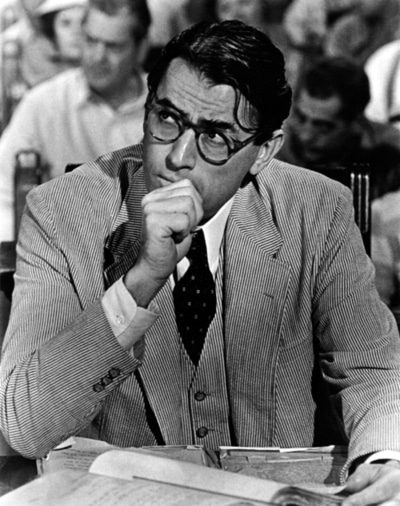
 Despite the fact that Bob Ewell “won” the case against Tom Robinson, he held a grudge against everyone who participated in the trial for revealing him as a base fool. After the trial, Ewell threatened Atticus’s life, grossly insulted him and spat in his face. In response, Atticus simply took out a handkerchief and wiped his face, prompting Ewell to ask:
 If Atticus had one dominating virtue, it was his nearly superhuman empathy. Whenever his children felt angry at the misbehavior or ignorance of the individuals in their town, he would encourage their tolerance and respect by urging them to see the other person’s side of things:
 Atticus is probably best remembered as an exemplary father. As a widower he could have shipped his kids off to a relative, but he was absolutely devoted to them. He was kind, protective, and incredibly patient with Jem and Scout; he was firm but fair and always looking for an opportunity to expand his children’s empathy, impart a bit of wisdom, and help them become good people.
This is from "The Art of Manliness" blog and I'd like to thank my sister Ginny for sharing it with me. You can find it at www.artofmanliness.com
Lessons in Manliness from Atticus Finch
When it comes to manly characters in literature, my thoughts always return to one man:
Atticus Finch.
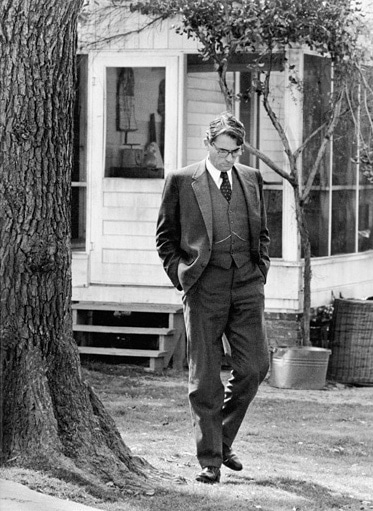
Perhaps this character from To Kill a Mockingbird seems like an unusual choice. A gentleman in a three piece suit. A widower of two kids, Jem and Scout. A man who was quiet instead of brash. Polite instead of macho. A lawyer who used his mind instead of his fists, who walked away from insults. Who didn’t gamble or smoke, who liked to walk instead drive. A man who liked nothing better than to bury himself in a book. Yes, Atticus may not seem very “manly,” at least when measured by the modern rubric for manliness.
But it is the subtlety of his manliness, the way he carried himself, taught his children, made his choices, that makes his manliness all the more real, all the more potent. His manhood was not displayed in great showy acts but in quiet, consistent strength, in supreme self-possession. The manliness of Atticus Finch does not leap off the page; instead, it burrows its way inside of you, sticks with you, causes your soul to say, “Now that is the kind of man I wish to be.”
The examples of honorable manhood that can be wrung from To Kill a Mockingbird are plentiful and powerful, and today we’d like to explore just a few.
Lessons in Manliness from Atticus Finch
A man does the job no one else wants to do.
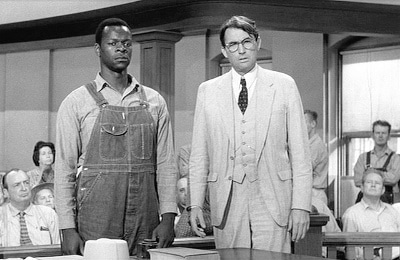
To Kill a Mockingbird unfolds against the backdrop of Atticus’s representation of Tom Robinson. Robinson, a black man, has been accused by Mayella Ewell, a white woman, of rape. While Atticus is assigned to be Robinson’s public defender by a judge, he earns the townspeople’s ire in his determination to actually defend him, honorably and fairly, to the best of his abilities.
He does the job that must be done, but that other people are unwilling and afraid to do.
Indoors, when Miss Maudie wanted to say something lengthy she spread her fingers on her knees and settled her bridgework. This she did, and we waited.“I simply want to tell you that there are some men in this world who were born to do our unpleasant jobs for us. Your father’s one of them.”“Oh,” said Jem. “Well.”“Don’t you oh well me, sir,” Miss Maudie replied, recognizing Jem’s fatalistic noises, “you are not old enough to appreciate what I said.”
A man stands in the gap and does what must be done. Doing so earns the respect even of one’s most ardent critics; after facing a myriad of taunts and threats from his neighbors for his defense of Tom Robinson, Atticus is once more re-elected to the state legislature …unanimously.
A man lives with integrity every day.
In Maycomb County, Atticus was known as a man who was “the same in his house as he is on the public streets.” That was the standard he lived by. He did not have one set of morals for business and one for family, one for weekdays and one for weekends. He was incapable of doing anything that would broach the inviolable sanctity of his conscience. He made the honorable decision, even when that decision was unpopular.
“This case, Tom Robinson’s case, is something that goes to the essence of a man’s conscience-Scout, I couldn’t go to church and worship God if I didn’t try to help that man.”“Atticus, you must be wrong…”“How’s that?”“Well, most folks seem to think they’re right and you’re wrong…”“They’re certainly entitled to think that, and they’re entitled to full respect for their opinions,” said Atticus, “but before I can live with other folks I’ve got to live with myself. The one thing that doesn’t abide by majority rule is a person’s conscience.”
Atticus understood that a man’s integrity was his most important quality-the foundation upon which his honor and the trust of others was built. Stripped of integrity, a man becomes weak and impotent, no longer a force for good in his family or community.
“If you shouldn’t be defendin’ him, then why are you doin’ it?”“For a number of reasons,” said Atticus. “The main one is, if I didn’t I couldn’t hold up my head in town, I couldn’t represent this county in the legislature, I couldn’t even tell you or Jem to do something again.”“You mean if you didn’t defend that man, Jem and me wouldn’t have to mind you any more?”“That’s about right.”“Why?”“Because I could never ask you to mind me again. Scout, simply by the nature of the work, every lawyer gets at least one case in his lifetime that affects him personally. This one’s mine.”
The most important form of courage is moral courage.
There are different types of courage: physical, intellectual, and moral.
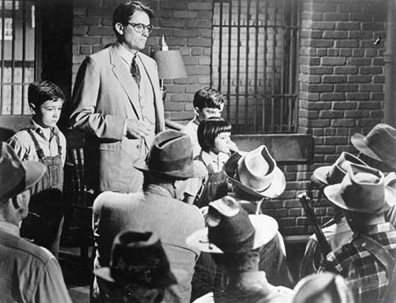
While unassuming, Atticus certainly possessed physical courage; when Tom was in jail, he sat outside all night reading and faced down an angry mob intent on lynching the prisoner.
But moral courage is arguably the most important type of bravery, and this Atticus had in spades. Moral courage involves the strength to stick with your convictions and do the right thing, even when the whole world criticizes and torments you for it. Atticus’s decision to represent Tom Robinson brought a slew of insults and threats to him and his family. But he was willing to bear the onslaught with head held high.
Moral courage also supplies the fortitude to take on a fight you know you’ll lose, simply because you believe the cause to be honorable. Atticus knows that he will lose his defense of Tom Robinson. When Scout asked him why he continued to press on, Atticus answered:
“Simply because we were licked a hundred years before we started is no reason for us not to try to win.”
Atticus used the example of Mrs. Henry Lafayette Dubose to teach Jem the power of this kind of moral courage.
Mrs. Dubose was a sick, cantankerous old woman who would berate Jem and Scout whenever they passed by her house. Jem tried to heed his father’s counsel to be a gentleman, but finally snapped one day and tore up her flower beds. As punishment, Atticus made Jem read books to Mrs. Dubose every day after school. She hardly seemed to pay attention to his reading, and he was relieved when his sentence finally ended.
When Mrs. Dubose died soon afterwards, Atticus revealed the true nature of Jem’s assignment. She had been a morphine addict for a long time, but wanted to overcome that addiction before she left the world; Jem’s reading had been a distraction as she worked to wean herself from the drug. Atticus explained to Jem:
“Son, I told you that if you hadn’t lost your head I’d have made you go read to her. I wanted you to see something about her-I wanted you to see what real courage is, instead of getting the idea that courage is a man with a gun in his hand. It’s when you know you’re licked before you begin but you begin anyway and you see it through no matter what. You rarely win, but sometimes you do. Mrs. Dubose won, all ninety-eight pounds of her. According to her views, she died beholden to nothing and nobody. She was the bravest person I ever knew.”
Live with quiet dignity.
Despite the fact that Bob Ewell “won” the case against Tom Robinson, he held a grudge against everyone who participated in the trial for revealing him as a base fool. After the trial, Ewell threatened Atticus’s life, grossly insulted him and spat in his face. In response, Atticus simply took out a handkerchief and wiped his face, prompting Ewell to ask:
“Too proud to fight, you nigger-lovin’ bastard?”
“No, too old,” Atticus replied before putting his hands in his pockets and walking away.
It’s often thought that the manly thing to do is answer tit for tat. But it can take greater strength to refuse to sink to another man’s level and to simply walk away with dignity. Frederick Douglass said, “A gentleman will not insult me, and no man not a gentleman can insult me.” This was a credo Atticus lived by.
Atticus’s quiet dignity was also manifested in his authentic humility.
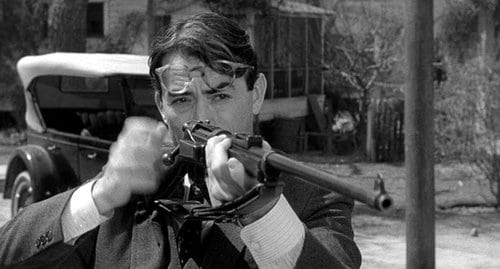
At one point in the book, Jem and Scout feel disappointed in their father; at 50, he is older and less active than the dads of their peers. He doesn’t seem to know how to do anything “cool.” This opinion is transformed when Atticus takes down a rabid dog with a single bullet, and they learn that their father is known as the “deadest shot in Maycomb County.” Jem becomes duly impressed with his father for this display of skill, all the more so because Atticus had never felt the need to brag about his prowess.
“Atticus is real old, but I wouldn’t care if he couldn’t do anything-I wouldn’t care if he couldn’t do a blessed thing.”Jem picked up a rock and threw it jubilantly at the carhouse. Running after it, he called back: “Atticus is a gentleman, just like me!”
Cultivating empathy is paramount.
If Atticus had one dominating virtue, it was his nearly superhuman empathy. Whenever his children felt angry at the misbehavior or ignorance of the individuals in their town, he would encourage their tolerance and respect by urging them to see the other person’s side of things:“If you can learn a simple trick, Scout, you’ll get along a lot better with all kinds of folks. You never really understand a person until you consider things from his point of view—until you climb into his skin and walk around in it.”
Atticus understood that people could only be held responsible for what they knew, that not everyone had an ideal upbringing, that folks were doing they best they could in the circumstances in which they found themselves. Atticus strove above all to see the good in folks and to figure out why they did the things they did.
When Scout complained about her teacher embarrassing a poor student, Atticus got her to see that the teacher was new in town and couldn’t be expected to know the background of all the children in her class right away. When a poor man that Atticus had helped with legal problems showed up in the mob to hurt him and lynch Tom, Atticus defended him, explaining that he was a really good man who simply had some blind spots and got caught up in the mob mentality.
Even when Bob Ewell spit in his face, he responded with empathy:
“Jem, see if you can stand in Bob Ewell’s shoes a minute. I destroyed his last shred of credibility at that trial, if he had any to begin with. The man had to have some kind of comeback, his kind always does. So if spitting in my face and threatening me saved Mayella Ewell one extra beating, that’s something I’ll gladly take. He had to take it out on somebody and I’d rather it be me than that houseful of children out there. You understand?”
Teach your children by example.
Atticus is probably best remembered as an exemplary father. As a widower he could have shipped his kids off to a relative, but he was absolutely devoted to them. He was kind, protective, and incredibly patient with Jem and Scout; he was firm but fair and always looking for an opportunity to expand his children’s empathy, impart a bit of wisdom, and help them become good people.“Do you defend niggers Atticus?” I asked him that evening.“Of course I do. Don’t say nigger, Scout. That’s common.”“’s what everybody else at school says.”“From now on it’ll be everybody less one.”
As a father he let his kids be themselves and nurtured their unique personalities. During a freak snowstorm in Alabama, Jem, determined to build a snowman from the scant snow on the ground, hauled a bunch of dirt from the backyard to the front, molded a snowman from the mud, and then covered the mudman with a layer of snow. When Atticus arrived home, he could have been angry with the kids for messing up the lawn, but instead, he was pleased with Jem’s enterprising creativity.
“I didn’t know how you were going to do it, but from now on I’ll never worry about what’ll become of you, son, you’ll always have an idea.”
Atticus’s sister wished that tomboy Scout would wear dresses, play with tea sets, and be the “sunshine” for her father; she often hurt Scout’s feelings with her disparaging remarks. But when Scout asked her father about this criticism:
He said there were already enough sunbeams in the family and to go about my business, he didn’t mind me much the way I was.
And he bought her what she wanted for Christmas-an air rifle.
Most of all, Atticus taught Jem and Scout by example. He was not only always honest with them, he was honest in everything he did himself.
He not only read them the newspaper each evening, but modeled a love of reading himself. And as a result, his kids devoured every book they could get their hands on. (Modern studies actually bear the truth of this out; kids with fathers who read are more likely to read themselves).
And he not only taught his children to be courteous, he was a model of courtesy and kindness himself, even to prickly types like Mrs. Dubose:
When the three of us came to the house, Atticus would sweep off his hat, wave gallantly to her and say, “Good evening, Mrs. Dubose! You look like a picture this evening.”I never heard Atticus say like a picture of what. He would tell her the courthouse news, and would say he hoped with all his heart she’d have a good day tomorrow. He would return his hat to his head, swing me to his shoulders in her very presence, and we would go home in the twilight. It was times like these when I thought my father, who hated guns and had never been to any wars, was the bravest man who ever lived.
Sunday, June 1, 2014
Subscribe to:
Comments (Atom)